

There is no question that China’s economic scale, industrial rise and expanding global presence are reshaping the dynamics of the world economy. A transformation of such magnitude will inevitably bring adjustment, competition and pressure to certain sectors and economies. That is precisely why narratives such as the “China Shock” and “China Squeeze” are so easy to sell: they offer a simple and intuitive way to describe the change.
But as many economists have argued and as growing evidence has shown, focusing solely on who faces greater competition risks overlooking the broader ways in which China is reshaping the global economy.
In times of crisis, Chinese demand, production capacity and supply chains have helped absorb external shocks. For developing economies, China’s market, equipment, technology and investment have expanded, rather than narrowed, the space for industrialization. And as Chinese companies go global, their presence is increasingly taking the form of local production, employment, technology transfer and participation in the green transition.
Three recent stories released by China’s Xinhua News Agency explore this often-overlooked side of the picture, examining where China acts as a buffer, expands opportunities and helps other economies build capacity, rather than a source of shock.
The first introduces the idea of a “China Buffer” -- China’s role in cushioning the global economy against disruptions, from energy shocks and supply-chain stress to inflation and climate challenges.
The second extends that idea to the Global South, arguing that China’s market, equipment, technology and investment are not competing for a fixed share of global production, but can help enlarge the economic pie and provide a “ladder” for industrial upgrading.
The third puts that argument to the test in one of China’s most globally visible industries: new energy vehicles. From Spain and South Africa to Brazil and Malaysia, it looks at how Chinese automakers are increasingly creating local jobs, building supply chains and supporting the green transition.
Taken together, the three stories highlight China’s capacity and willingness to work with others, expand opportunities, and confront shared global challenges, underscoring the role China can play as a buffer and a source of resilience for the world economy.
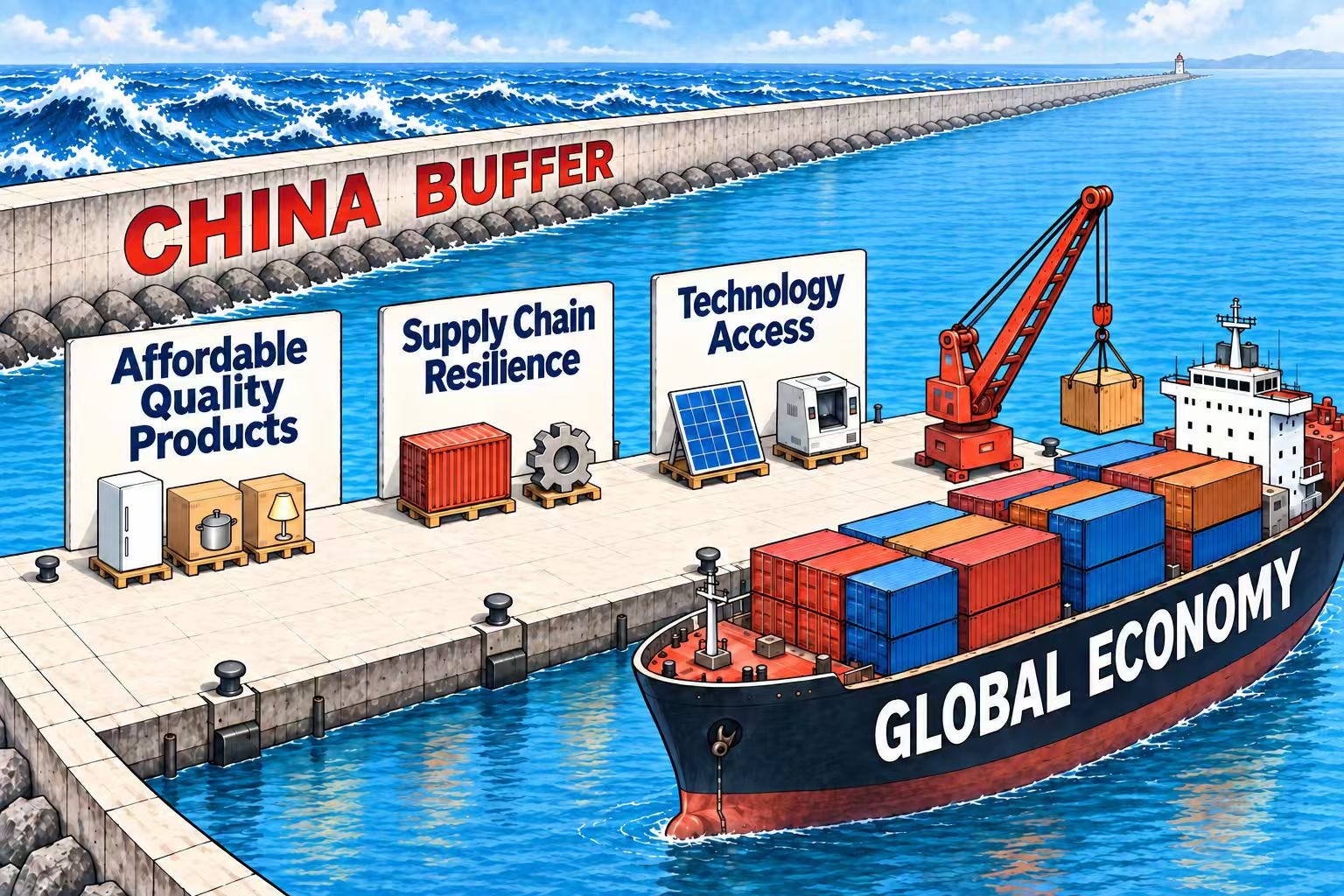
“China Shock” or “China Buffer”?
Economic Watch: “China Buffer” stabilizes world economy amid tensions, crisis
The first story introduces the idea of the “China Buffer.”
It begins with the latest disruption to oil flows through the Strait of Hormuz. As energy markets came under pressure, China sharply reduced crude imports, drawing on inventories, lower refinery runs and a changing energy mix. The result, according to the International Energy Agency, was a meaningful easing of pressure on the global oil market.
The episode offers a window into a broader pattern.
During the 2008 financial crisis, China sustained demand when much of the world was in recession. During the COVID-19 pandemic, its early manufacturing recovery helped supply medical products and everyday goods worldwide. More recently, China’s large and efficient manufacturing base has helped cushion supply shortages and inflationary pressures, while falling costs for Chinese solar panels, batteries, wind turbines and electric vehicles have made the green transition more affordable.
The story therefore challenges viewing China through the lens of a “shock.” At critical moments, it argues, China has instead functioned as a shock absorber -- a source of supply, demand and resilience for the global economy.
“China Squeeze” or a Bigger Global Economic Pie?
News Analysis: China’s rising tide lifts more than its own boats
The second story takes on another assumption: that China’s industrial rise inevitably leaves less room for other developing economies. This argument treats the global economy as a fixed pie, but industrial development rarely works that way.
Over the past decade, economies including Vietnam, Cambodia and Laos have substantially increased their shares of global exports even as China remained a manufacturing powerhouse. At the same time, China has become an increasingly important market for the Global South and a major supplier of machinery, intermediate goods and capital equipment.
The article describes China as increasingly becoming a “factory to the factories.” Chinese textile machinery has helped developing economies build manufacturing capacity. Chinese companies investing overseas are creating local jobs, bringing technology and connecting host economies more deeply with global supply chains. And newer technologies -- from artificial intelligence to smart manufacturing -- are creating additional opportunities for industrial upgrading.
Two images capture the idea: a rising tide and a ladder. China’s growth can help raise demand and enlarge markets -- the rising tide. Its equipment, technology, capital and know-how can also give developing economies more tools to move up the industrial ladder.
The question, then, is not who takes a larger slice of an existing pie, but how the pie itself becomes larger.
Chinese EVs Go Global: Competition, but Also Cooperation
Economic Watch: Racing overseas, Chinese NEVs drive the world towards green, shared growth
The third story brings the argument down to the level of a single industry: new energy vehicles.
Chinese EV exports are growing rapidly, but the story looks beyond export numbers to ask what happens when Chinese automakers enter overseas markets.
In Spain, cooperation between Chery and EV Motors helped revive the historic Ebro auto brand and brought production back to factories that had once fallen silent. In South Africa, Chery retained all 692 employees at the Rosslyn plant it acquired and expects its operation to support thousands of jobs across the supply chain. In Brazil, BYD is building not only vehicles but also a local ecosystem of production, R&D, employment and suppliers.
And in Malaysia, dealers say Chinese brands are changing long-held perceptions of Chinese cars, with consumers increasingly associating them not simply with affordability but with technology, safety and performance.
These cases illustrate a shift from “made in China and sold abroad” to “made with local economies.”
They also highlight another dimension of the story: affordability. China’s scale, battery technologies and intense market competition have helped lower the cost of electric mobility, making the green transition more accessible beyond wealthy economies.
Chinese automakers are still at an early stage of globalization. But their expanding overseas footprint provides a useful test of the wider “China Squeeze” argument: Does greater Chinese participation necessarily crowd others out, or can investment, competition and localization create new economic activity at the same time?
Beyond a Zero-Sum Lens
Taken together, the three stories point to a common idea. China’s economic rise undoubtedly brings competition and adjustment. But competition is only part of the picture.
China is simultaneously a major consumer market, a manufacturing hub, a supplier of capital goods and intermediate inputs, an investor, a source of technology and an increasingly important force in the global green transition.
Seen through that wider lens, the choice between “China Shock” and “China Buffer” is ultimately a question of how the global economy itself is understood.
If economic development is viewed as a zero-sum contest over a fixed amount of production, China’s rise can easily appear as displacement.
If growth is also understood as a process of creating new markets, lowering costs, spreading technology and expanding productive capacity, a different picture emerges.
China is not simply taking part in the global economic pie. In many areas, it is helping make the pie bigger.